
In high-volume construction, framing, and industrial manufacturing, speed and structural integrity are paramount. Efficiency relies completely on your mechanical delivery system: the pneumatic nailer and its fuel source, the collated fastener.
Collated fasteners are simply nails or staples bound together in strips or coils using a specific medium. This allows for rapid, continuous firing without manual reloading. However, the material holding those fasteners together—plastic, paper, glue, or wire weld—is not just a packaging choice. It directly impacts your pneumatic tool’s performance, the angle of the magazine, job site safety, cleanup time, and building code compliance.
Choosing the wrong collation type can cause frequent tool jams, compromised finishes, or costly project delays. This guide provides a detailed technical breakdown of each collation type, mapping them to the job site environments where they perform best.
Plastic Collated Fasteners:
Rugged and Weather-Resistant

Plastic collation uses rigid or semi-flexible plastic strips to hold nails together, typically aligned at a 20-degree to 22-degree angle. As the firing pin strikes the nail head, it shears the nail away from the strip, fracturing the plastic.
Technical Mechanical Evaluation
-
Durability: Plastic strips are entirely waterproof. Unlike paper, they do not degrade when exposed to morning dew, heavy rain, or wet mud on a raw framing site.
-
Collation Angle: Usually restricted to 20°–22° stick configurations with full round head nails.
-
The Advantage: Exceptional durability in harsh environments. Because the plastic strips are 100% waterproof and impervious to mud, rain, and snow, they will not degrade on a wet job site. This ensures every strip feeds flawlessly into your 20° to 22° framing nailer, even after being left in the bed of a truck or exposed to a sudden downpour.
Shop Freeman Plastic Collated Fasteners
Freeman PFR2190 Pneumatic 21-Degree 3-1/2" Framing Nailer is engineered to handle heavy-duty plastic collated framing nails ranging from 2" to 3-1/2". Built with a hardened steel drive blade and an ergonomic magnesium body, the PFR2190 delivers reliable, high-contrast, professional-grade performance through the toughest dimensional lumber, ensuring crisp shearing without magazine jams.
Paper Collated Fasteners:
The Clean, High-Capacity Standard

Paper tape collation binds nails together using a high-tensile paper strip reinforced with specialty resin glues. This method is predominantly used for 30-degree to 34-degree framing stick nails. When fired, the paper tape does not shatter; instead, it is driven cleanly into the wood substrate directly beneath the nail head.
Technical Mechanical Evaluation
-
Zero Job Site Debris: Because the paper is consumed during the drive cycle, there are no plastic shards or wire fragments left to clean up on the deck or lawn.
-
High Magazine Capacity: The steep 30°–34° angle allows nails to be closely nested (clipped head or offset full round head), meaning more nails fit into a shorter, more maneuverable magazine.
-
The Advantage: The Upside: Maximizes on-site efficiency and leaves a pristine finish. The steep 30° to 34° angle allows nails to be tightly nested together, packing significantly more fasteners into a single strip to cut down on reload interruptions. Additionally, the paper tape shears cleanly and drives completely into the wood, leaving a spotless workspace with zero debris to clean up afterward.
Shop Freeman Paper Collated Fasteners
Freeman G2FR3490 Pneumatic 34-Degree Framing Nailer Designed specifically for high-capacity, agile site work, the G2FR3490 runs 30° to 34° paper tape collated nails. The steep magazine profile allows operators to easily access tight framing corners and joist cavities that flatter-angled tools simply cannot reach, while keeping the work area free of plastic debris.
Wire Weld Collated Fasteners:
High Volume for Coils

Wire weld collation uses two parallel strands of thin, coated steel wire that are spot-welded directly to the shanks of the nails. While occasionally used in straight sticks, this method is the absolute standard for 15-degree coil framing and siding nailers.
Technical Mechanical Evaluation
-
Extreme Volume Capacity: Wire weld allows nails to be wound into large coils containing 200 to 300+ nails. This massive payload dramatically cuts down on reloading downtime, making it perfect for production-line crating, continuous roof sheathing, and subfloor installation.
-
Universal Resilience: Unaffected by extreme heat, cold, or water immersion.
-
The Advantage: Unmatched capacity for nonstop production. By linking 200 to 300+ fasteners into a single continuous coil, wire-welded collation dramatically minimizes tool downtime. This makes it the ultimate powerhouse for high-speed, repetitive applications like roofing and siding, where stopping to reload every few minutes slows down momentum.
Shop Freeman Wire Collated Fasteners
Freeman G2CN65 2nd Generation Pneumatic 15-Degree 2-1/2" Coil Siding Nailer Engineered to dominate high-volume siding, fencing, and sheathing applications, the second-generation G2CN65 is optimized to run 15-degree wire weld collated coil nails seamlessly. This professional-grade tool features an upgraded hardened steel drive blade, transparent bucket design, and tool-free depth adjustment, allowing you to maximize the massive payload capacity of wire weld coils while maintaining precise, high-contrast depth control on every shot.
Glue Collated Fasteners:
Seamless Finish and Precision

Glue collation relies on a continuous bead of specialized thermal adhesive or flexible polymer glue applied directly along the contact points of the fastener shanks. This is the dominant method for finish nails, brads, and heavy-duty construction staples.
Technical Mechanical Evaluation
-
Flawless Aesthetics: No plastic shards, paper fibers, or metal wires interfere with the drive. The fastener enters the material perfectly clean, which is essential for stain-grade finish carpentry and cabinetry.
-
Lubrication Effect: The friction generated as the fastener enters the wood melts the residual adhesive coating. This acts as a brief lubricant for smoother penetration, then re-hardens inside the wood fibers, increasing the long-term holding power.
-
The Advantage: Seamless aesthetic results and added holding power. Perfect for fine finish work, brads, and heavy-duty stapling, glue collation leaves behind absolutely no debris or fragments under the fastener head. As an added mechanical benefit, the intense friction of the drive briefly melts the adhesive, which then cools to form a tight thermal bond between the fastener and the wood fibers.
Shop Freeman Glue Collated Fasteners
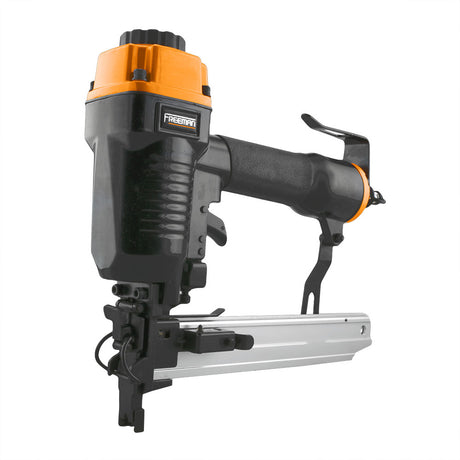
Freeman G2FS9 2nd Generation Pneumatic 9-Gauge 2" Fencing Stapler When structural integrity meets heavy-duty livestock fencing, vineyard wires, or utility grounding, the second-generation G2FS9 delivers unmatched performance. Engineered to process heavy-duty, glue-collated 9-gauge fencing staples flawlessly, this tool leverages the thermal bonding power of residual adhesive to maximize holding power in treated posts. Its high-contrast, rugged design ensures seamless, precise depth driving without any collation debris compromising the strength of your outdoor perimeters.
Engineering Comparison Matrix
To visualize how these collation materials perform side-by-side, consult the technical matrix below:
|
Collation Type |
Typical Angles |
Best Applications |
Primary Advantage |
Primary Drawback |
|
Plastic Strip |
20° – 22° |
General Framing, Sheathing |
100% waterproof, durable |
Flying plastic debris; unflush heads |
|
Paper Tape |
30° – 34° |
Framing, Joists, Rafters |
Zero site mess; tight nail nesting |
Degrades in wet environments |
|
Wire Weld |
15° (Coil) |
Siding, Fencing, High-Volume Roofs |
High-capacity payload (200-300 nails) |
Rust spots; metal spark discharge |
|
Glue / Adhesive |
0° – 34° |
Finish, Trim, Staples, Brad Nails |
Invisible joints; thermal bonding power |
Strips break easily if dropped |
How Mechanics and Code Dictate Your Choice
When purchasing fasteners, you must match the physical parameters of your pneumatic tool. The pitch angle of your nailer's magazine must match the pitch angle of the fastener strip exactly.
Attempting to force a 21-degree plastic collated nail into a 34-degree paper tape magazine will jam the drive track, deform the feeder shoe, and potentially fracture the driver blade.
Furthermore, always check local building codes. Some structural jurisdictions restrict the use of clipped-head nails (frequently found on high-density 30°–34° paper tape options) in high-wind or seismic zones, requiring full-round-head nails instead (typically found on 21° plastic or 15° wire weld variants).
Conclusion: Match the Medium to the Mission
There is no single "best" collation material. The right choice depends on your working environment and project goals:
-
Choose Plastic Strips for wet, outdoor framing where durability matters most.
-
Choose Paper Tape for efficient, high-speed interior framing and zero field cleanup.
-
Choose Wire Weld Coils for non-stop production line crating, siding, and roofing.
-
Choose Glue Collation for pristine finish work, cabinetry, and interior trimming.
No matter what your job demands, pairing high-quality, spec-matched fasteners with a professional pneumatic tool from Freeman Tools ensures your speed, safety, and performance remain completely uncompromised.