
Walk into any woodworking shop or residential construction site, and you’ll see an array of fastening tools. But if you’re staring at a row of delicate trim molding, an unassembled cabinet chassis, or a heavy door casing, grabbing the wrong gun can completely ruin your workpiece.
Choosing between a finish nailer vs. brad nailer or a narrow crown stapler comes down to three things: mechanical holding power, material thickness, and how much of a visible footprint you want to leave behind.
This comprehensive nail gun gauge guide breaks down the mechanics, sizing, and exact applications for each tool so you can choose the perfect match for your next project.

1. The Finish Nailer: Heavy-Duty Interior Holding Power
When structural stability matters but you still need a clean, professional appearance, a finish nailer is your go-to tool. These heavy-duty guns are designed to drive thicker fasteners deep into dense hardwoods and structural framing.
Sizing & Mechanics: 15-Gauge vs. 16-Gauge
Finish nailers typically utilize 15-gauge or 16-gauge fasteners.
The Fastener Gauge Rule: In the tool world, the smaller the gauge number, the thicker the fastener.
Because 15G and 16G nails feature a distinct, recognizable head, they provide massive mechanical holding power. However, they will leave a noticeable hole in your wood surface that requires wood putty, wood filler, and sanding before painting or staining.
Best Finish Nailer Uses
-
Installing thick baseboards and heavy crown molding
-
Hanging interior and exterior door casings
-
Securing chair rails and window trim
-
Assembling stair rails, risers, and treading
Featured Freeman Tools & Fasteners
-
The Tool: The Freeman PFN64 Pneumatic 16-Gauge 2-1/2" Straight Finish Nailer is engineered with a lightweight, durable magnesium housing and a tool-free depth adjust. It delivers the driving force needed for tough hardwoods without causing user fatigue.
-
The Fasteners: Pair your rig with Freeman 16-Gauge Straight Finish Nails (available in lengths up to 2-1/2") to guarantee jam-free execution and maximum structural hold.

2. The Brad Nailer: High Precision, Low Visibility
If you are working with delicate wood strips, thin trim, or intricate crafting components, a heavy finish nailer will split the wood instantly. That is where the nimble brad nailer comes in.
Sizing & Mechanics: The 18-Gauge Profile
Brad nailers run on ultra-thin 18-gauge wire fasteners. Because the entry profile of an 18G brad nail is so slim, it rarely splits thin trim boards, MDF, or plywood.
The best part? The hole left behind is so small it often doesn't require wood filler—a quick coat of paint or primer completely hides it. The compromise here is holding power. Brad nails rely heavily on wood glue to do the permanent structural lifting; the brads simply act as an immediate mechanical clamp while the adhesive cures.
Best Brad Nailer Uses
-
Attaching delicate shoe molding and quarter-round
-
Assembling picture frames, birdhouses, and home crafts
-
Securing paneling, shiplap, and wainscoting
-
Holding furniture trim and cabinetry accents in place while glue dries
Featured Freeman Tools & Fasteners
-
The Tool: For ultimate on-site portability, the Freeman PE20V2118G2 20V Cordless 2-in-1 18 Gauge 2" Brad Nailer / Narrow Crown Stapler gets the job done without a compressor. If you prefer a classic workshop workhorse, choose the Freeman PBR50Q Pneumatic 18-Gauge 2" Brad Nailer with Quick Jam Release, featuring a no-mar safety tip to protect your finish surfaces.
-
The Fasteners: Keep your magazine loaded with premium Freeman 18-Gauge Brad Nails for crisp, straight penetration across all fine trim applications.

3. The Narrow Crown Stapler: Unrivaled Surface Area Grip
Nails are exceptional for resisting shear force, but they can easily pull straight through thin backing materials. When you need to anchor thin sheets of wood, lattice, or composite material down firmly, you need a two-pronged attack.
Sizing & Mechanics: 1/4" Narrow Crown Staples
Narrow crown staplers typically drive 18-gauge, 1/4" narrow crown staples. Instead of a single pin entry like a brad or finish nail, a staple features a "crown"—the horizontal bridge connecting the two legs.
This bridge acts as a mini-clamp, physically wrapping over the fibers of the material. It distributes the holding force over a much wider surface area, ensuring thin materials won't tear away from the frame under pressure.
Best Narrow Crown Stapler Uses
-
Fastening cabinet backs and furniture backing panels
-
Installing cedar shingles, underlayment, and house wrap
-
Assembling wooden crates, shipping pallets, and garden lattice work
-
Soffit, fascia, and fencing installation
Featured Freeman Tools & Fasteners
-
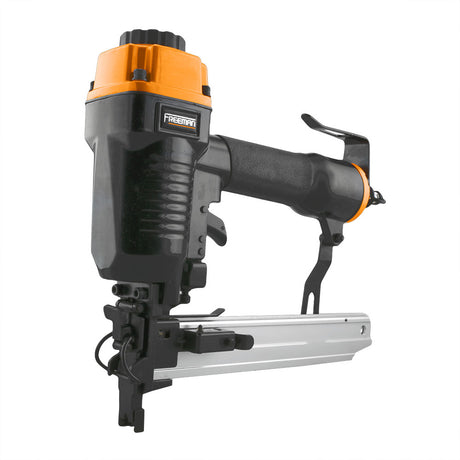
The Tool: The Freeman PST9040Q Pneumatic 18-Gauge 1/4" Narrow Crown Stapler features a quick-release nose for easy jam clearing and a 360-degree adjustable exhaust to keep air and workshop debris away from your face.
-
The Fasteners: Load up your magazine with Freeman 18-Gauge 1/4" Narrow Crown Staples. Engineered with sharp chisel points, these staples drive flush without buckling to provide maximum surface grip.
Quick Reference Guide:
Finish Nailer vs. Brad Nailer vs. Stapler
To help you choose the right tool for your next home improvement or professional contracting job, use this quick reference chart:
|
Tool Type |
Fastener Gauge |
Key Benefit |
Primary Application |
|
Finish Nailer |
15G / 16G |
High holding power, handles structural weight |
Heavy interior trim, door casings, baseboards |
|
Brad Nailer |
18G |
Microscopic hole, won't split delicate wood |
Shoe molding, picture frames, cabinetry trim |
|
Narrow Crown Stapler |
18G (1/4" Crown) |
Wide surface grip, prevents material pull-through |
Cabinet backs, subfloors, soffits, lattice |
By matching the correct Freeman pneumatic tool or cordless nailer to your specific material thickness, you'll guarantee cleaner finishes, stronger joints, and a more efficient workflow on every single project.
Ready to upgrade your workshop? Explore the full lineup of Freeman Tools Fastening Solutions.