
Ask any framing crew lead what slows down production on a multi-home rough-in, and the immediate answer is usually material staging or labor bottlenecks: hauling 2x6s, wrangling subfloor sheathing, and humping laminated veneer lumber (LVL) across joists.
Rarely does anyone point straight at the 8- to 10-pound tool hanging from their dominant arm.
Yet, by 2:30 PM on an 85-degree day, the signs of cumulative joint strain are unmistakable: nails driven proud, bruised palms, erratic trigger pacing, and crew members shaking out their wrists between wall sections.
If your crew is battling mid-afternoon slumps, the problem usually isn't worker stamina, it's the cumulative physics of front-heavy nailers and unabsorbed drive recoil. Here is how modern pneumatic ergonomics and recoil engineering protect joint health, cut misfires, and sustain high-volume framing speed all day long

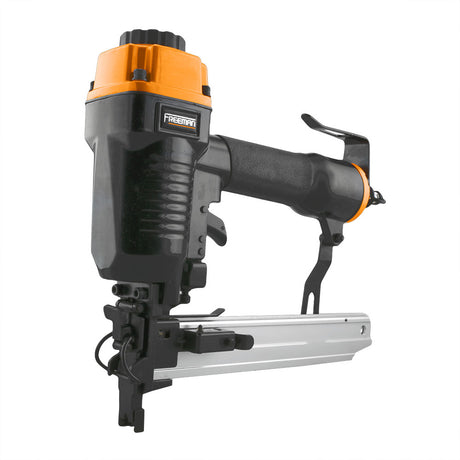
G2FR2190 - Pneumatic 21 Degree 3-1/2" Framing Nailer (2nd Generation)
1. The Physics of Drive Recoil: Why Center-of-Gravity Outweighs Raw Tool Weight
When shopping for framing nailers, spec sheets emphasize static dry weight. But on the jobsite, dynamic balance and recoil dissipation dictate how your body actually feels after 2,000 cycles.
The Lever-Arm Effect
A tool weighing 8.2 lbs with a nose-heavy balance profile creates a continuous downward rotational torque on the carpal tunnel and forearm flexors. To keep the contact safety nose depressed against top plates or bottom plates:
-
The wrist must remain in an extended, isometric contraction.
-
Every degree of tilt away from the tool's natural center of mass multiplies tendon load.
-
Well-balanced pneumatic framing nailers, engineered with an ergonomic magnesium housing and an optimized inline magazine, place the center-of-gravity squarely directly above the trigger hand, eliminating the constant forward pry.
What Happens During Piston Impact?
When a pneumatic nailer cycles at 90–115 PSI, the piston slams downward with several hundred inch-pounds of kinetic energy to sink a 3-1/2" × .131" framing nail. The equal and opposite reaction sends an impulse shock directly back up the tool body.
If the nailer lacks an internal recoil dampener and a textured, anti-vibration grip, that shockwave bypasses the tool housing and travels straight through:
-
The thenar eminence (base of the thumb)
-
The radiocarpal wrist joint
-
The medial epicondyle (leading to severe "tennis elbow" / tendonitis)
By pairing lightweight magnesium alloy bodies with progressive internal dampening bumpers, high-performance pneumatic tools absorb the sharp deceleration curve internally rather than dumping it into the framer's joints.

G2CN90- Pneumatic 15° 3-1/2" Coil Framing Nailer (2nd Generation)
2. The Real-World Production Impact: Fewer Misfires, Cleaner Toenails, and Sustained Pace
Ergonomics on a jobsite isn't just a comfort metric, it directly dictates your bottom line and punch-list hours.
Elimination of Flagging and Proud Nails
When operators tire, they subconsciously pull back or ease off downward pressure right as the trigger trips. This micro-flinch causes the safety contact to back off slightly, resulting in:
-
Proud nail heads that require manual pounding with an axe or hammer.
-
Skipped studs and compromised shear values.
-
Surface gouging from slipping contact tips.
A balanced pneumatic tool with a precise tool-free depth-of-drive wheel allows the gun to do 100% of the work. The framer simply positions the sharp, aggressive toenail claw into the grain, trips the bump-fire trigger, and lets the pneumatic volume seat the nail flush every cycle.
Tight-Bay Agility (Toenailing and Corner Blocking)
Toenailing between 16" on-center studs or pinning tight corner blocks requires unnatural body angles. Overly bulky or tail-heavy tools force carpenters into awkward, one-handed overhead reaches. A compact 21° or 33° pneumatic frame with high clearance allows natural pivoting into the 45-degree angle required by building codes, without having to fight the hose line or the magazine swing.

G2FR2190 - Pneumatic 21 Degree 3-1/2" Framing Nailer (2nd Generation)
3. The Jobsite Checklist: Outfitting Your Crew for Speed & Power in Engineered Lumber
Engineered lumber (LVL beams, LSL studs, and PSL posts) is notoriously dense, frequently causing battery-powered or poorly sealed framing tools to stall out or leave heads standing 1/4" proud.
To maintain maximum cycling speed and all-day comfort without sacrificing penetration power in dense framing timber, audit your setup against this checklist:
|
Feature / Component |
What to Look For |
Why It Matters on the Jobsite |
|
Housing Material |
One-piece magnesium alloy body |
High tensile strength that withstands 6-foot drops while shaving critical pounds off total tool weight. |
|
Depth Adjustment |
Tool-free, indexed thumb wheel |
Allows instant transitions from soft SPF studs to rock-hard LVL headers without reaching for hex keys. |
|
Air Delivery System |
3/8" ID air hose with high-flow couplers |
Prevents CFM air starvation during rapid multi-nail bump firing into subflooring or gang-laminated beams. |
|
Magazine Angle |
21° Full Round Head or 30°–34° Clipped/Offset |
Matches local building code while balancing compact length for tight rafter runs and corner assemblies. |
|
Contact Element |
Hardened aggressive-toe claw |
Bites into wet or frozen dimensional lumber to prevent slips during fast, angled toenailing passes. |
|
Grip & Exhaust |
Molded rubber dampening grip + 360° adjustable exhaust |
Keeps tool oil and cold exhaust air directed away from the face while dissipating shock cycles. |
The Verdict: Protect the Crew to Protect the Schedule
Framing is a game of repetition. Saving just two seconds per connection by avoiding proud-nail hand tapping and reducing tool reset fatigue translates to hundreds of man-hours saved over the course of a multi-family tract or custom build.
Investing in pneumatic framing tools engineered around balanced center-of-gravity, anti-recoil internals, and lightweight durability isn’t a luxury, it’s the fastest way to keep your crews firing at full speed from morning layout to end-of-day sweep.