
If you’ve ever shopped for an air compressor, you’ve likely seen specs like "150 PSI" and "2.6 CFM @ 90 PSI" splashed across the tank.
For many woodworkers and DIYers, these numbers cause immediate confusion. A common assumption is that if a compressor delivers 120 PSI, it can easily run any nail gun on the job site. But halfway through framing a wall, the gun starts misfiring, sinking nails only halfway, or the compressor motor runs nonstop until it overheats.
The culprit? CFM (Cubic Feet per Minute), not PSI.
To help you get the right setup without overspending or stalling your projects, this guide breaks down the exact CFM requirements for a framing nailer versus a finish nailer—and clarifies once and for all how air pressure differs from air volume.
The Big Confusion: CFM (Volume) vs. PSI (Pressure)
Before comparing nailers, let’s clear up the difference between PSI and CFM. Think of compressed air like a garden hose:
-
PSI (Pounds per Square Inch) = The Pressure. This is the force behind the air. PSI determines whether the nail gun has enough punch to drive a fastener flush into dense lumber. Most pneumatic nailers operate between 70 and 120 PSI.
-
CFM (Cubic Feet per Minute) = The Volume. This is the amount of air the compressor can supply continuously. Every time you pull the trigger, a burst of air volume is consumed. CFM determines how fast and frequently you can fire without draining the tank.
Key Rule of Thumb: PSI drives the nail; CFM keeps up with your speed. Almost any portable compressor can reach 90–120 PSI, but small compressors cannot sustain the high CFM demanded by heavy-duty tools.
Compressor Requirements: Framing Nailer vs. Finish Nailer
| Nailer Type | Typical Fastener Size | Operating PSI | Recommended CFM (@ 90 PSI) | Recommended Tank Size |
| Finish / Brad Nailer (15–18 Ga.) | 5/8" to 2-1/2" | 70 – 110 PSI | 0.3 – 1.0 CFM | 1 to 3 Gallons (Pancake / Hot Dog) |
| Framing Nailer (21° or 30° Paper/Plastic) | 2" to 3-1/2" | 70 – 115 PSI |
2.0 – 2.5 CFM (DIY) 4.0+ CFM (Fast / Crew) |
6 Gallons minimum (Up to 10–20 Gal for crews) |
1. What CFM Do You Need for a Finish Nailer?
Whether you’re installing baseboards, crown molding, or building cabinetry with a Freeman 15-Gauge or 16-Gauge Finish Nailer, finish work is precise and rhythmic rather than rapid-fire.
-
Air Consumption: A finish nailer only consumes about 0.3 to 0.8 CFM per shot at 90 PSI.
-
Compressor Needs: A compact 1 to 3-gallon pancake or trim compressor delivering around 1.5 to 2.0 CFM @ 90 PSI is more than enough.
-
Why it works: Because the internal piston in a finish nailer is relatively small, it requires very little air volume to sink a slender 15- or 16-gauge nail into softwoods or hardwoods.
2. What CFM Do You Need for a Framing Nailer?
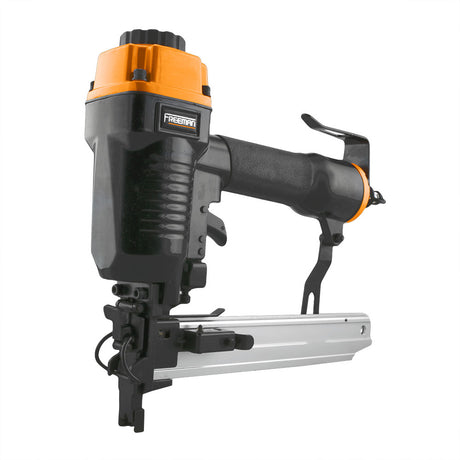
Framing nailers (like the Freeman PFR2190 or G2FR2190) drive thick, 3-1/2" round-head or clipped-head nails into dense structural framing lumber.
-
Air Consumption: Driving large fasteners requires a significantly larger internal cylinder and piston, expelling 2.0 to 2.5 CFM under moderate use, and upwards of 4.0 to 5.0+ CFM if you are bump-firing across subflooring or wall studs.
-
Compressor Needs:
-
For DIYers / Solo Remodelers: A portable 6-gallon pancake compressor producing 2.6 to 3.0 CFM @ 90 PSI will work, provided you pause occasionally to let the tank recover.
-
For Production Framing / Rapid Bump-Firing: Look for a compressor that provides at least 4.0 to 5.0 CFM @ 90 PSI, paired with a 6 to 10+ gallon tank (or a dual-tank wheeled unit).
-
-
The Risk of Low CFM: If your compressor delivers less than 2.0 CFM, your framing nailer will fire 2–3 nails properly, then suddenly leave the 4th nail protruding half an inch because the tank pressure has plunged below operating specs.

The Role of Tank Size (Why CFM Still Matters More)
People often ask: "If I have a 6-gallon tank, does CFM still matter?"
Yes. Think of the air tank as a buffer:
-
When you fire a framing nailer rapidly, you are drawing air faster than the compressor pump can create it.
-
The air stored in the tank cushions that demand.
-
However, once the tank drops below its "kick-in" pressure (cut-in pressure), the pump turns on to replenish it.
If your compressor has a large tank but low CFM, the motor will run continuously for minutes to recharge, causing heat buildup and project downtime. CFM dictates recovery time.
3 Quick Tips to Choose the Perfect Freeman Setup
-
Calculate the 1.5x Safety Rule:
Take the highest CFM rating of your nailer and multiply it by 1.5. If your framing nailer calls for 2.5 CFM, buy a compressor rated for at least 3.75 CFM @ 90 PSI for smooth, uninterrupted operation.
-
Account for Hose Length & Diameter:
Running a 100-foot, 1/4" air hose causes significant pressure drop. If you work on scaffolding or framing roofs, upgrade to a 3/8" polyurethane air hose to ensure maximum CFM and pressure reach the tool.
-
Multi-Tool Setups:
Running two trim carpenters off one compressor? Add their CFM needs together:
$$1.0\text{ CFM} + 1.0\text{ CFM} = 2.0\text{ CFM minimum at 90 PSI}.$$
The Verdict
-
Finish & Brad Nailers: Require high precision, not high airflow. A lightweight, ultra-portable 1.5 to 2.0 CFM compressor handles them effortlessly.
-
Framing Nailers: Require substantial air volume to sink large nails consistently. Target 2.5 to 3.0 CFM @ 90 PSI for light DIY projects, or 4.0+ CFM for framing crews and deck builders.
Ready to upgrade your job site? Browse Freeman’s line of pneumatic framing, finish, and combo kits built for pro-grade performance and efficient air consumption.